Robert Polidori is a photographer known for his architectural studies and frequent contributions to magazines and books. He was born in 1951 in Montreal, Canada, to a French Canadian mother and a Corsican father. He moved to the United States when he was ten and arrived in New York in 1969, where he got a job as an assistant to a filmmaker Jonas Mekas at the Anthology Film Archives, producing a number of avant-garde films in the early 1970s. In 1980 he received an M.A. from the State University of New York at Buffalo and subsequently turned his attention to still photography. He has been living in Paris and New York City since 1987. He is listed as a staff photographer with The New Yorker magazine and makes frequent contributions to other magazines such as Vanity Fair.
After Hurricane Katrina, Robert Polidori went to New Orleans, where he lived years ago, to shoot photographs of the devastation for The New Yorker. He stayed longer than first planned, then went back again and again, for weeks, taking hundreds of pictures with a large-format camera that produced wide, superbly detailed color photographs. The camera was awkward to manipulate through the wreckage and in the heat, without electricity and lights.
These are photographs, in other words, without nostalgia, as Mr. Rosenheim writes in a short introduction to Mr. Polidori's book, "After the Flood," but with "something of the air that generations of anonymous New Orleanians had breathed in and out." They make "no attempt to excavate what went wrong in New Orleans or why the state and federal response remains even today predisposed to cronyism, gross fraud and corruption." They simply testify, as Mr. Rosenheim puts it, "to a city that care forgot."
Currently in first year studying art & design at Limerick School of Art & Design (LSAD). This is a blog documenting my research and development of our first year brief "To Sense My Space".
Wednesday, 7 November 2012
Tuesday, 6 November 2012
Boundary-Breaking Art
Japanese award winning artist Yuki Matsueda certainly knows how to think outside-of-the-box. His art, featuring everyday objects, look as though parts of them are attempting to break free! Egg yolk, puzzle pieces and the suits of playing cards are no match for the artist who retains ultimate control.
I enjoy how there's a sense of movement to each piece. While simple, Matsueda's art is certainly original and interesting.
Friday, 26 October 2012
Wednesday, 24 October 2012
Chris Maynard is a feather fanatic!
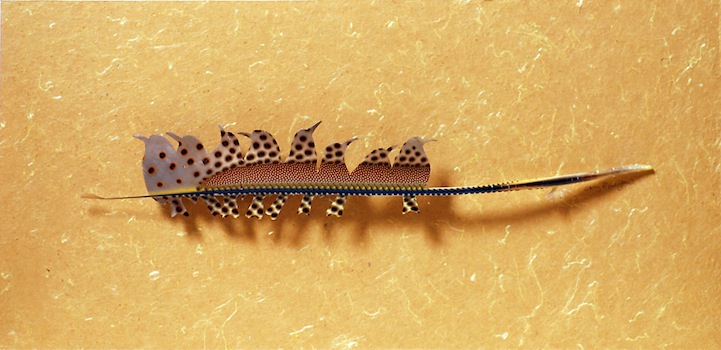
Washington-based artist Chris Maynard is a feather fanatic! He uses feathers as his medium because he says, "They are an ultimate achievement of nature and a pinnacle of wonder." His goal is to feature the natural patterns, colors, and shapes of a bird's feathers in a new and different light compared to how it originally grew and functioned on the bird's body.
WIth this in mind, Maynard creates all kinds of interesting shadowbox designs that mimic the natural form of a bird's feathers. In his work, layers of overlapping feathers, single isolated feathers, and repetitive patterns are the main focus. From that central point, the artist carves intricate feather birds that grow and emerge, and flap their wings as they fly away.
As unique as every bird, each one of Maynard's pieces is an original that cannot be duplicated. Maynard says creation of these pieces requires various design and crafting techniques and that his favorite tools to use are his fine eye surgery forceps, scalpels, and magnifiers. He spends a lot of time identifying the proper feathers to use to complete his vision and all of the shadowbox framings incorporate only legally acquired materials.
WIth this in mind, Maynard creates all kinds of interesting shadowbox designs that mimic the natural form of a bird's feathers. In his work, layers of overlapping feathers, single isolated feathers, and repetitive patterns are the main focus. From that central point, the artist carves intricate feather birds that grow and emerge, and flap their wings as they fly away.
As unique as every bird, each one of Maynard's pieces is an original that cannot be duplicated. Maynard says creation of these pieces requires various design and crafting techniques and that his favorite tools to use are his fine eye surgery forceps, scalpels, and magnifiers. He spends a lot of time identifying the proper feathers to use to complete his vision and all of the shadowbox framings incorporate only legally acquired materials.
Tuesday, 23 October 2012
The Feeling of Rust
DOVES [Kingdom of Rust]
I'm now looking into using different textures to give my work a greater appeal to those with limited senses [TOUCH]. . .
In an effort to replicate the rusty texture of a barrel, I decided to melt crayons on paper, using an iron. The result looked good but in relation to how it felt . . . . well the melted wax clumped to produce a bumpy, blotchy effect which felt waxy to touch. It may not be very textural but it was something simple to begin with and also LOTS OF FUN!
I used a cheese grater, greaseproof paper,
crayons, ironing board, iron and a large sheet of white paper.
I started by grating a green crayon onto the paper.
I decided to mix it with yellow.
Placing the greaseproof paper on top, I melted the crayon.
The result looked something like this.
The setup in the kitchen.
Super fun time with crayons. :P
Adding more colours. . . . . . .
Because of the consistency of the crayon, the paper was translucent around the waxy spots,
so it was see through under bright light!
Really love these shots. :)
Subscribe to:
Posts (Atom)